For a record-breaking seventh consecutive quarter, the Courtiers Multi-Asset range delivered positive returns, surpassing the previous record run achieved between mid-2012 and 2013.
The Cautious Risk Fund, Balanced Risk Fund, and Growth Fund returned +0.42%, +1.22%, and +1.92%, respectively. The equity funds – comprising the Global (ex-UK) Equity Income Fund, the UK Equity Income Fund and the Ethical Value Equity Fund – returned +5.89%, +5.39% and +3.12%, respectively, in the quarter. The Investment Grade Bond Fund returned -1.50%, as government borrowing costs rose to levels not seen in decades.
Whilst some vessels were able to transit the Strait of Hormuz, shipping activity remains well below historical levels as geopolitical tensions re-escalated during the quarter. With winter approaching and energy inventories having been drawn down, markets have become increasingly sensitive to any potential supply disruptions. Oil prices, as measured by Brent Crude, rose by +42%, after falling -38% during the previous quarter, adding to broader inflationary pressures across major economies.
These inflation concerns have led to speculation of further rate hikes in the UK. Elsewhere, central banks have already begun to respond. In September, the US Federal Reserve raised interest rates for the first time since 2023. The European Central Bank acted even more swiftly, delivering two rate increases during the quarter. The shift in policy rhetoric from both central banks highlights growing concerns that the disinflationary progress seen over the past two years may prove more fragile than previously expected, with policymakers increasingly focused on preventing a resurgence in longer-term inflation expectations.
The rate at which the UK government can borrow for (the 10-year Gilt yield) rose sharply during the quarter, reaching 5.42%, its highest level since 2007. Longer-dated borrowing costs also moved significantly higher, with the 30-year Gilt yield climbing above 6% for the first time in more than 30 years. The increase reflected growing concerns over inflation, elevated government borrowing requirements and expectations that interest rates may need to remain higher for longer. As a result, UK government bonds came under pressure, particularly at the longer end of the yield curve, where higher yields translated into weaker bond prices, resulting in the FTSE Gilts All Stocks Index falling -2.53% and long-dated gilts (over 15 years to maturity) declining -5.38%.
Rising rates normally affect smaller companies more than larger ones, but this was not the case in Q3, as the UK economy proved resilient with GDP growth exceeding expectations. The FTSE 100 (the largest 100 companies in the UK) returned +1.82%, but smaller companies as measured by the FTSE 250 and the FTSE Small Cap Index, had a fantastic quarter, returning +9.61% and +7.28%, respectively.
The Courtiers funds have built significant exposure to smaller companies over the last few years, as valuations have been attractive. The Multi-Asset Funds built a new position in the FTSE 250 index, and the equity funds have been increasing their exposure to smaller companies as the investment process allocates capital to attractively valued businesses. This strong quarter for smaller companies provided a tailwind for fund performance, particularly in the UK Equity Income and Global (ex-UK) Equity Income Funds.
The US bucked the global trend of smaller and mid-sized companies outperforming, with the S&P 500 (the 500 largest companies in the US) returning +2.3%, while the S&P 400 (the next 400 mid-sized companies) and the S&P 600 (a further 600 smaller companies) returned -6.36% and -7.93%, respectively. The US economy has enjoyed remarkable growth in recent years and, despite facing similar government borrowing cost pressures to many other developed economies, its inflationary pressures appear more typical of an economy operating close to full capacity, with resources becoming increasingly stretched.
Europe was largely flat in the quarter, with the Eurostoxx 50, representing 50 of Europe’s largest companies, falling -0.62%.
Emerging markets delivered a mixed performance over the quarter, ultimately declining -1.05%. South Korea’s KOSPI index continued its rollercoaster ride (as described in James’s July update), falling -19.19%. India also struggled, declining -5.22%, with higher oil prices acting as a headwind for the oil-importing economy. In contrast, China defied expectations, rising +3.50% in the quarter, supported by renewed government stimulus measures. Brazil was among the standout performers, rising +7.07%, benefiting from its status as a major commodity exporter and from higher energy prices.
Currency markets were relatively subdued outside of Japan. The Japanese yen strengthened +3.32% against sterling as the unwinding of carry trades gathered pace. In contrast, both the US dollar and euro were broadly unchanged against the pound over the quarter, with investors balancing resilient economic growth against the prospect of slower monetary easing from major central banks.
Commodity markets told two very different stories. Industrial metals continued to rally, with copper rising +8.02% over the quarter. Often referred to as “Doctor Copper” for its reputation as a barometer of global economic health, the metal benefited from evidence that the global economy has remained remarkably resilient despite the recent inflation shock. Precious metals were comparatively subdued given the geopolitical backdrop, with gold gaining +3.19% and silver rising +0.92%. While ongoing global tensions would normally be expected to provide stronger support for precious metals, resilient economic data and rising bond yields limited investor demand for traditional safe-haven assets.
Interview Transcript
Leo Hallam (Head of Marketing)
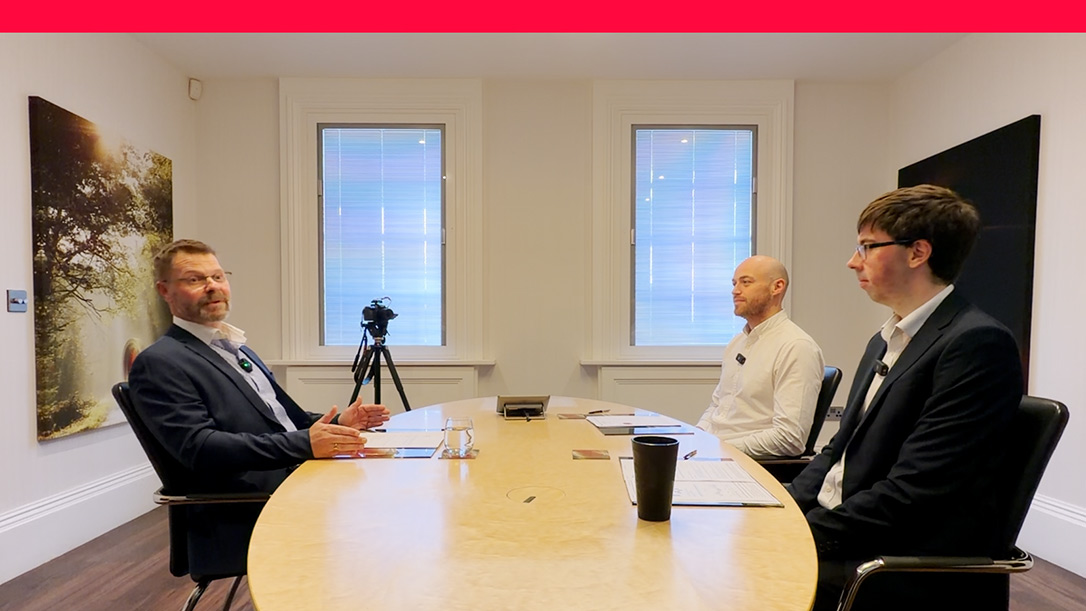
I’m here with Asset Management Director Jake Reynolds and Head of Asset Management and Fund Manager James Timpson to find out what’s been happening in Courtiers funds and around the world throughout the last quarter. James, let’s start with you. Six quarters of positive fund performance. That’s a year and a half. Are we still moving forward positively?
James Timpson (Head of Asset Management)
Well Leo, we have some record breaking news, as all three Multi-Asset Funds have just had their seventh consecutive positive quarter, which has never happened before.
Leo Hallam
A Magnificent Seven of sorts.
James Timpson
Indeed, it’s our own Magnificent Seven. Yes. It’s never happened in the 19 years that we’ve been managing these funds. And it’s a testament to how, how resilient markets have been. All the volatile events that we’ve seen over the last over a year and a half. And just to give you some numbers. So over the last quarter, the Growth Fund returned just under 2% balanced 1.2% and Cautious just under half a percent.
If you look at year-to-date returns for the funds so far, Growth fund is now at 14.5%. Balanced fund 11.5% and Cautious just under 8.5%. So it’s been another really strong year for the funds so far. And also in the last quarter, it’s been a particularly strong month for the equity funds. So the UK fund and the Global funds that we manage, they both returned over 5% last month. And the Ethical fund as well returned over 3%.
Leo Hallam
And that leaves us just with the Bond fund.
James Timpson
And of course the Bond fund. Perhaps unsurprisingly, given all the turmoil that we’ve seen in the bond market lately, that was the only negative performer that was down around 1.5%.
Leo Hallam
Well done to you and the team, Jake. Some varied results. What’s driving it?
Jake Reynolds (Asset Management Director)
We manage seven strategies: the Cautious, Balanced and Growth. Then we have the Global Fund and the UK fund, the Ethical fund which are all 100% equities. And then we have the Bond fund. And actually the varying results told the story of the quarter. So we’ve got good diversified, resilient multi-asset funds delivering positive quarterly results again.
But like James alluded to, the Equity funds are up quite a lot. And that’s because they’ve been building over the years, particularly since 2022. They’ve been building this exposure to small and mid caps that perform really well, particularly in the UK. The normally when rates are rising these small caps go down. But we’ve noticed that been on such great valuations that we’ve been we’ve been building the positions and they have just with some GDP growth that’s been above expectations.
So the economy has been resilient. And also there’s this thing where people have just, I think, finally had enough of the shocks and started taking matters into their own hands. And you see that manifesting in the copper price. That’s up 9%. And the GDP and business investment, which is up at 5.2%. So we shouldn’t get greedy because pre Brexit business investment used to run at 10% per annum.
And before that GDP growth would be running at 2 to 3. But it’s good that we’re still getting positive. But the benefit was that there was an expectation of zero. But it’s just people taking matters into their own hand and sorting out a more volatile world and and investing for their own energy security, putting solar panels on top of factories. Stuff like this has actually driven driven the UK forth.
Leo Hallam
I hear all this and long-term value investing. That’s where you guys are driven to do. That’s what all your models are designed to achieve. So what I’m hearing is you’re achieving what you set out to achieve. Is the change in people’s attitudes part of this, or are you detecting that and altering your strategies? How does it work? Are you surprised that you’re doing well seven quarters in a row – positive? It’s what you guys are designing things for.
Jake Reynolds
I think on the I mean, we got lucky with some timing. Let’s. I think it’s fair to say, you know, the way when tariffs fell and I think we alluded to that as a quarterly when the Iranian US conflict fell. So it is it’s timing. But overall the performance over the long run is exactly what we expect when you have these strategies.
Then we go into the great details. We go into the weeds that are in these quarterly videos and we go, oh, you know, this is from estimates up a little bit. And that’s actually pushed the small caps. But the truth is they look really cheap. And we know that we back human ingenuity over the long run. And we talk. How many times we talk about the last couple of years with, you know, Saudis rerouting all or the Germans creating, liquified natural gas ports in record time because we have to deal with these shocks.
But it is a world of more shocks. And I think we’ll talk about that in a minute with interest rates. But I think the important thing is how we build those into the funds, which James really, is at the forefront of.
Leo Hallam
Tell us more…
James Timpson
As Jake mentioned, it’s been a really strong period for medium and smaller companies at the moment, which is why the UK and Global funds have done so well, and the Multi-Asset funds benefit from that, because not only are they invested in those UK and Global funds, but also in the last quarter we’ve rotated away from the FTSE 100 large cap, which has been really strong over the last few years, and into the FTSE 250 index, which is a UK mid-cap index.
We also invest in something called the Abaforth Smaller Companies Trust, which gives us exposure to UK smaller companies. And in the last quarter that’s returned 12%.
Leo Hallam
James you say “rotated away”. Just explain to us what that means.
James Timpson
All that means is we reduced our position in the FTSE 100 index, and we’ve put that exposure into the FTSE 250 index. So it’s a sale and a buy effectively.
Leo Hallam
Yeah. It’s slowly, slowly turning from one to another. Great.
Jake. You mentioned interest rates and there’s not a day goes by when I don’t hear record interest rates. What’s going on?
Jake Reynolds
It’s a tough time if you’re borrowing and you’re the government and particularly in the UK, the US and France, all for slightly different reasons but very similar. And so in the UK right now to borrow for UK government if it wants to borrow off you for ten years, it’s got to pay you 5.42%. That’s up from 4.76%.
But the real drama is on the long end of the curve. So this is when the UK government comes up and says, I need to borrow money for 30 years, and they are now having to pay this literally just as we’ve come down here, it’s now above 6%. So that’s highest it’s been since the late 90s. So what is causing that?
Well, there’s loads of speculation. People don’t really know what. What we can say is that people are demanding a lot more money to lend money to the UK government right now. Now, we were at conference on on Tuesday and, and people think that the, the the makeup of owners of gilts has completely changed over the last ten years.
You’ve lost the central banks buying because that’s what we were doing post the financial crisis and post Covid during Covid, which Gary has talked about at length but widely considered a mistake. And also, pension funds just don’t hold as many gilts anymore. You don’t have defined benefit pension schemes anymore that were always buying the long end of the curve.
So they talk about the active person at the long end of the curve – it’s discretionary investors like us and we started to put some money into long bonds, but we still want more. And that means that the government has to pay more. And this is the simple reason, is you’ve lost that price insensitive buyer of pension funds and central banks who don’t care what they were paying.
They just wanted to keep pumping money into the economy. Pension funds were hedging liabilities and they said they just needed to hedge. And that was actually a feedback loop. And at the end of the curve where the higher it went, the more they needed to buy. So you’ve lost you’ve lost those two price insensitive buyers and replaced it with people like us and hedge funds and global hedge funds that are more hotter money.
They’re not they’re not just going to keep buying. You need to make it interesting for us now it is starting to get interesting. Gary, I think for the last couple of years about when it gets interesting, we’ve started to dip our toe in. That has manifested in a little bit of a fall in in the Bond fund this quarter, down 1.5%, but the real long end of the curve.
UK gilts over 15 years have fallen over 5% in the quarter. So when interest rates go up, bonds go down. So that’s that’s why it’s been falling. But France is an interesting one because they’ve got an election, they’ve got political problems, they’ve got maybe fiscal problems. But right now.
LVMH. So Louis Vuitton Moët Hennessy, a big luxury goods conglomerate, can borrow money for ten years at 4.3%. But if you’re the French government, you have to you have to pay 4.8%. Which is quite unheard of because normally in finance you would consider the government tenure, the risk free rate. So the fact that a corporation can borrow at less money than, than the French government is quite absurd.
Leo Hallam
Another interesting statistic. Thanks, Jake. Now, as we run up towards the end of the year, there’s quite a lot happening, isn’t there? On the 28th of October, we’ve got the the Autumn Budget. Is there anything that you’re expecting there in your workload?
Jake Reynolds
Lots. But you know, we”ll position the portfolios won’t we and we’ll just have to watch it and just see what happens.
Leo Hallam
Sure, we’ll be covering all that as well.
Jake Reynolds
And do our normal thing. Office of Budgetary Responsibility productivity paper stats will come out and we normally download that simultaneously and have a look through whilst the budget’s on.
Leo Hallam
And we’ll be listening to that and reporting straight after the budget announcement as well.
3rd of November – US midterms…
Jake Reynolds
Could be active.
James Timpson
We’ll have to wait and see I think on that one.
Leo Hallam
And you guys are preparing some interesting and insightful presentations as well I understand. We will be returning to an online format this year.
We’ve got some exciting news to present to you very soon, so please keep an ear out for that.
James, Jake. You know I always like to ask, anything new this quarter – exciting that’s gone into the funds? But also I’d like to ask – out?
So James, we’ll start with you – in?
James Timpson
Continuing the theme of UK mid-caps that we’ve increased exposure to lately, one of the stocks we’ve bought in the UK Income Fund and the Ethical fund as well is Premier Foods. So this owns several brands which you’ll have heard of Mr. Kipling, Oxo, Bisto, and like most stocks in the fund, you know, it was originally selected by a model because it looks attractive relative to its peers and its peers, includes things like Tate and Lyle and Cranswick.
Leo Hallam
Have we still got Associated British Foods?
James Timpson
We do. We hold Associated British Foods.
Leo Hallam
So your cupboards are pretty full.
James Timpson
Yes, carry on filling your larders with all sorts, chances are we own the company. Fantastic. Hopefully it gives us some exceedingly good returns (laughter).
Leo Hallam
Well done James.
Jake – out?
Jake Reynolds
We had a really busy two quarters, actually. When we do this, we run some, some code on the database, and there’s about 45 positions that were were in and out. What is. Well, we’re closing financials, which is 200, 250%, something like that. Yeah. That was a position that we bought in the Silicon Valley blow up in 2023.
Leo Hallam
What’s financials? Is that a suite of…
Jake Reynolds
It was all the financials in the Euro STOXX 600. So it had some UK banks in there – European banks. So we have we’ve taken our financials exposure down looking a lot more fairly priced now but still quite attractive. And there’s still some opportunities out there. So we’ve switched from Lloyds to NatWest. We’re looking at a French bank which looking like everything in France is on sale at the moment given the, the political situation.
So we’ve closed that position down and as James alluded to the FTSE 100 future, we’ve still got options. But the future is gone and we’ve gone into that FTSE 250 mid-cap which is quite exciting.
Leo Hallam
Thank you both very much for the insight and for your time as always, and we’ll look forward to catching up with you as we approach December.
If you have any questions, please do speak to your adviser or contact us through the website, and as I say, we are preparing some very interesting presentations this year to deliver – in an online format, but there are some exciting plans also on how we’re going to work around those and invite your questions and participations.
So look forward to more. Thank you.