Is the UK really in as bad a shape as the headlines suggest? Gary Reynolds thinks the picture deserves a little more context.
In this catch-up with Leo Hallam, Gary discusses inflation, employment and the UK economy, alongside recent market volatility and the resilience of Courtiers’ investment strategy. He explains the importance of maintaining a long-term perspective when markets become volatile, rather than reacting when events have already unfolded, and offers a preview of what to expect in his upcoming annual client presentation.
The conversation also considers operational resilience and highlights the importance of access between the Courtiers’ Investment team, Courtiers financial advisers and clients.
Transcript
Leo Hallam (Head of Marketing)
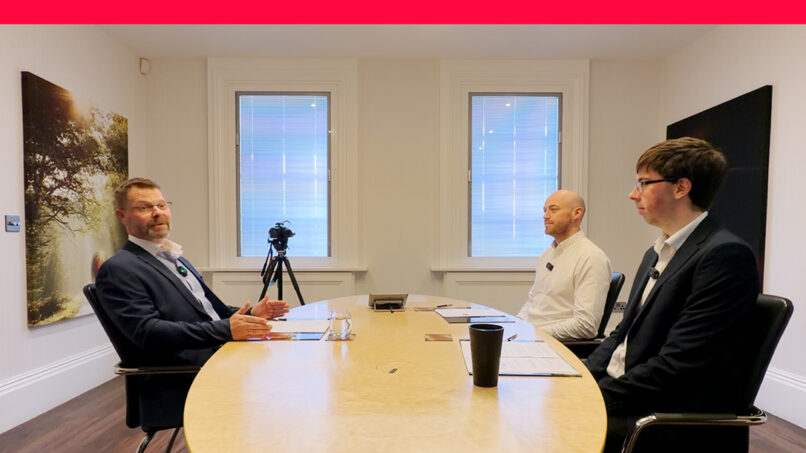
I’m with Courtiers Chief investment Officer Gary Reynolds for a general catch up and to find out what he’s going to be talking about in December.
Gary.
First of all, I wake up.
Inflation’s up. The highest it’s ever been. It’s all across the news.
You’re saying Britain’s in good shape?
Gary Reynolds (Chief Investment Officer)
Yeah, well, it’s the highest it’s ever been, depending on which period you’re taking.
So if you were if you were from the 70s when inflation was over 20%, clearly 3.6% isn’t the highest it’s ever been.
So it’s high and you’d wish it was lower, but it’s not like it was in the 70s.
And there’s a there’s a temptation for people to draw this analogy because it’s a last high inflation period.
And we were so used to this post global financial crisis period of zero increases in prices and in some cases, deflation, that we’ve now gone back to inflation.
And everybody’s panicking because, you know, if you’re if you’re in your 30s, 40s you think that 0.5% inflation is normal if you’re from the 70s like me, you think 3.6% is low.
So, you know, you’ve got to put this in context and you’ve got to look at what the world’s like today.
A lot of this shock has come through energy prices being high, because we’ve had a war in Ukraine and the Strait of Hormuz, tensions between Iran and the US, and that’s pushed push prices up.
But as I’ve said previously, oil is gone to just over $110 a barrel at peak.
Go back to the summer of 2008 and it was nearly $147.
So, you know, you’ve got to get things in context.
And sometimes we need to look back further to understand where we are today.
Leo Hallam
Well, the thing that’s hot in the news this week is these NEETs: not in education, employment or training.
Obviously, they would not have been in the 70s, this kind of age group.
So what kind of picture do you think’s being painted for them and how do you see that right now.
Gary Reynolds
Well they wouldn’t have been called NEETs in the 70s.
You’re right.
But there was a move.
If you go back to the 60 and 70s to try and increase the minimum age for leaving school, and the reason for that was to stop youngsters parlaying into employment and pushing up the unemployment levels.
So we do have a problem with these, you know, youngsters coming out of education and not finding anything to do.
And I think that, you know, I’ve got to say, I think the Labour Party has made this a lot worse by imposing a high minimum wage for young people and imposing extra NI on the salaries paid by employers to young people.
So an employment amongst young people is very, very high.
And I can tell you the number of applications we get at Courtiers for intern work now is through the roof compared to what it was a few years back, because youngsters are struggling to find opportunities and that is a bit of a worry.
And of course, the other thing with that, Leo, is that AI is potentially a threat to youngsters getting starter jobs, because Jake uses a phrase is that having eyes like having a thousand interns available to you.
Because AI will go off and bring this stuff in.
You’ve still got a check it.
Leo Hallam
It never sleeps.
Gary Reynolds
Absolutely. It just gets on with it. So that is an issue and needs resolving.
And the policies implemented by this government in the past two years have not helped.
And one thing I would say, if you listen to John Healey’s speech at the Labour conference, he talks about his first job being as a bottle washer in a in a pub, the Milburn Arms in North Yorkshire, and he says he learned a tremendous amount of that as a young person.
Why, then, do you want to stop youngsters getting a similar opportunity by disincentivising employers at taking on teenagers?
So I think that, you know, fine, giving those narratives and those anecdotes, but think about what your policy is doing to people that want those jobs.
Leo Hallam
Thanks, Gary. So just going back to the apparent state of the country and your views on that, isn’t this something you’re going to be touching on in your and your presentation in December?
Gary Reynolds
I am.
Leo Hallam
And can you give us a little insight?
Not all of it. Just a little insight.
Gary Reynolds
Well, the insight is, is this everybody’s saying that Britain’s in a terrible mess.
Highest borrowing rates in the G7.
Government borrowing out of control.
And I can categorically assure anybody looking at this that it isn’t.
And I will categorically spell out why this country is in a very, very strong position indeed.
And what we’ve suffered from is a plague of politicians that find their way into power by telling the electorate that we’re in a mess and then promising to resolve it.
And the difficulty is, once they get into power, they can’t change that narrative, because otherwise it looks like they’ve lied about what happened previously.
And I’m afraid there’s been a tendency of this happening over the last ten years.
It happened with Brexit, when a lot of the data went out was just terribly inaccurate.
And it’s happened.
And in fairness, you know, it’s not specific to the Labour Party who just happened to be the party in power.
The Tories did it in 2010 when they wanted to get elected and then again in 2015.
So both sides have been doing it.
But the problem is it it depresses the public.
It makes everybody feel worse off.
And the truth is we’re in good shape.
And I’ll tell you why.
When we do the Seminar.
Leo Hallam
You’ve said strong position, good shape.
Let’s talk about the recent resilience of the Courtiers funds how you’ve achieved that.
Gary Reynolds
Well it’s not really recent decisions.
I think anybody that follows our circulars and these, these types of talks over the last few years, will know for certain that we have warned against getting overcommitted towards large US tech companies.
And when we were steering away from those in 2021, it was very good because they had a really bad time in 2022 and we picked up a bunch of awards 2023, 2024 with AI becoming very popular, NVIDIA, Microsoft, Apple, Tesla, the Mag 7, all extremely popular markets did very well.
They form a huge part of the S&P 500, the main index for US stocks, they were flying and we weren’t doing so well at all.
But the point I was making was when we’re making decisions, we know our investors.
We know who are in the funds, their institutions like charities, pension funds with long term horizons, and they’re individuals with long term horizons.
A great deal of them that are relying on this money to maintain the standard of living for the rest of their lives.
So you’ve got to take decisions to enable those institutions and those people to achieve their objectives.
Punting US large tech at massive multiples is, in my book, not a credible ten year strategy.
So we haven’t done that.
And this year the benefits really came through.
You know, we’ve looked incredible against the markets.
The funds have done very well as James will explain.
And Jake and so – put it this way, it’s much nicer doing this chat in 2026 and it was in 2023 and 2024.
So I know doing this job which I’ve done for very many years, you’re going to have difficult years and you’ve just got to suck it up and get on with it.
But you mustn’t ever lose sight that your strategy is to deliver your clients objectives with lower risk as possible.
Leo Hallam
Stick to strategy.
That’s what you and the investment team have done.
And I think Jake said recently in response to the Big Tech sell off.
The happened overnight.
Knocked a big chunk off the Nasdaq and $3 trillion off US stocks.
Something along the lines of if you have to change course, you’re already losing.
Gary Reynolds
Yeah that’s that’s right. Yeah. That’s that’s it.
You know if, if, if, if it’s a Paolo Maldini approach which economist friend of, of mine Dario Perkins comes out with.
He’s a big Italian fan.
And Maldini was one of the best defenders in the world going back into the 80s.
Always said if I have to make a tackle, I failed already.
So his point was if you do your job right, you don’t have to make that last ditch tackle.
And I think that’s that’s what it’s a bit like for us if we’re suddenly if you go back, sort of think of 2016 when I use this as an example, because we were quite short sterling going into the Brexit vote, just in case it went the wrong way, even though we thought the country would vote remain.
Then when it happens, you get you get benefits.
But if we were trying to rush to short sterling on the morning of the vote, the decision was declared no chance.
So when you hit a crisis, you hit it with whatever is in your portfolio.
Trying to change when you’re into it, it’s nigh on impossible and very, very expensive.
Leo Hallam
You’ll be among a herd, surely.
Gary Reynolds
You will, you’ll be.
You’ll be in. You’ll have a whole lot of pain.
You’ll be offloading assets at rock bottom prices.
And I’m not saying you don’t make some adjustments.
Of course you do.
Sometimes you have to change.
But the best way, the nicest thing when you hit a crisis is when the stuff that you’ve got has done really well.
Some of the stuff you didn’t have has bottomed out.
And you can sell that, sell some of your stuff at good prices to buy what have become bargain basement prices in other assets.
So yeah, that’s the type of tactical change you want to do.
Trying to insure against the loss as it’s happening is like trying to is is like finding you’ve got a fire in the bedroom.
You’ve forgotten to insure your, your house and ringing up the insurance company and says, my, my house is ablaze.
Can I insure it, please?
And you know, you know what?
They’re going to know what they’re going to say to you.
Leo Hallam
Relating to the big tech stocks, we were reminded recently about how much we rely on these things with the outages on Microsoft.
Gary Reynolds
Yeah.
Leo Hallam
How did that impact the investment team?
What about our cyber resilience from an operational perspective and investment management perspective?
Gary Reynolds
Well, we like all companies have got a nice department that is always mindful of fact that you’re you’re you’re trying to ensure everything is secure.
But when you do get an outage like that, we have other ways in which we can communicate.
So we’re not completely reliant on Microsoft.
We’ve got other types of communication methods that we can we can go to and the team go straight to those.
So from the investment team point of view is pretty seamless.
I’d say from for the client point of view, it’s a bit frustrating because if you’re trying to send emails into us, you can’t get them through.
You know, there’s nothing we do because they’re just not hitting anyone.
Leo Hallam
No, but I think when it’s global like that, everybody sort of accepts it and get some with it.
Gary Reynolds
So actually for the for the investment team and the day it was it was business as usual.
Leo Hallam
Thanks, Gary.
Well with all the cold spells on the way, snow forecast and the lights, we’re looking forward to some bright shining information in your December presentation and also presentations from Jake and James.
Very much looking forward to all of those.
But while are we talking about those?
What’s the difference with this format?
What are you hoping to achieve with the investment team?
Gary Reynolds
Well, I think the the online version is itself quite popular.
But we’re doing it this way this year because there’s a considerable amount of workload within the business on rolling out the new propositions.
And that’s on the the advisory side of the business.
So the advisers are going to be flat out through to next spring, basically.
So we can’t get on our feet, we can’t get them out there and they have to be in attendance at those seminars.
So we’re back online this year, which we’ve done previously.
So it’s not the first time we’ve, we’ve done this, but for anybody watching, you know, I would expect to be pulling a cracker and having, you know, sharing a bit of Christmas turkey with them in December 2027.
And if you’re saying to me, which format would you prefer?
I like I like meeting people face to face, probably because of my age, and I’m old fashioned like that.
So just to put everybody’s mind at rest, this is not our intention of doing this format every year, but this year it’s just been necessary because of workloads.
Leo Hallam
Yeah.
And technology lets us get really valuable information out there.
Gary Reynolds
So yeah it does.
And we can still get our messages across.
And people can we can still people can still see what we’re thinking at macro level within the funds, within individual positions.
We’re going to cover all those as we normally do.
And I think the other thing is worth pointing out to clients is that if they want to hop on for the live, interaction with myself and the investment team in January, then please do so and they’ll be able to sort of chat through questions during during the talk.
So that’s very much geared for allowing people to come on and, and, and quiz the team.
Leo Hallam
And that will be a great insight for clients into the regular CIO talks that you hold with all of the advisers.
Gary Reynolds
Yeah. There’s that monthly every month. Yeah.
There’s a, there’s a, there’s a CIO talk and I think that, you know, that is something quite unique to courtiers.
I’m not saying we’re the only ones that do it, but it’s, it’s it’s, it’s something we put a lot of store in that there is a vertical integration and that the investment team are accessible to the investors, which which the vast majority of companies, of investment companies in this country, the investors will not get access to the actual people that are making the day to day decisions on their funds.
But at Courtiers we we make sure that happens.
And, you know, I’ve always been a big believer in that because I think that asset management companies that know their clients intimately will be more mindful of the risks they’re taking when they’re conscious, there’s a person’s lifestyle at the end of it.
So this, for me is a very, very important part of what Courtiers does.
Leo Hallam
Well right here, right now is testament to your accessibility and the team’s.
You know, I can say, Gary, can we have a quick catch up?
And most of the time you’re able to just pop down and here we go.
General chit chat.
Leo Hallam
That’s great.
Well thank you for this one.
And again, I look forward to your presentation in December.
If you have any questions, please speak to your Courtiers Adviser or contact us.